

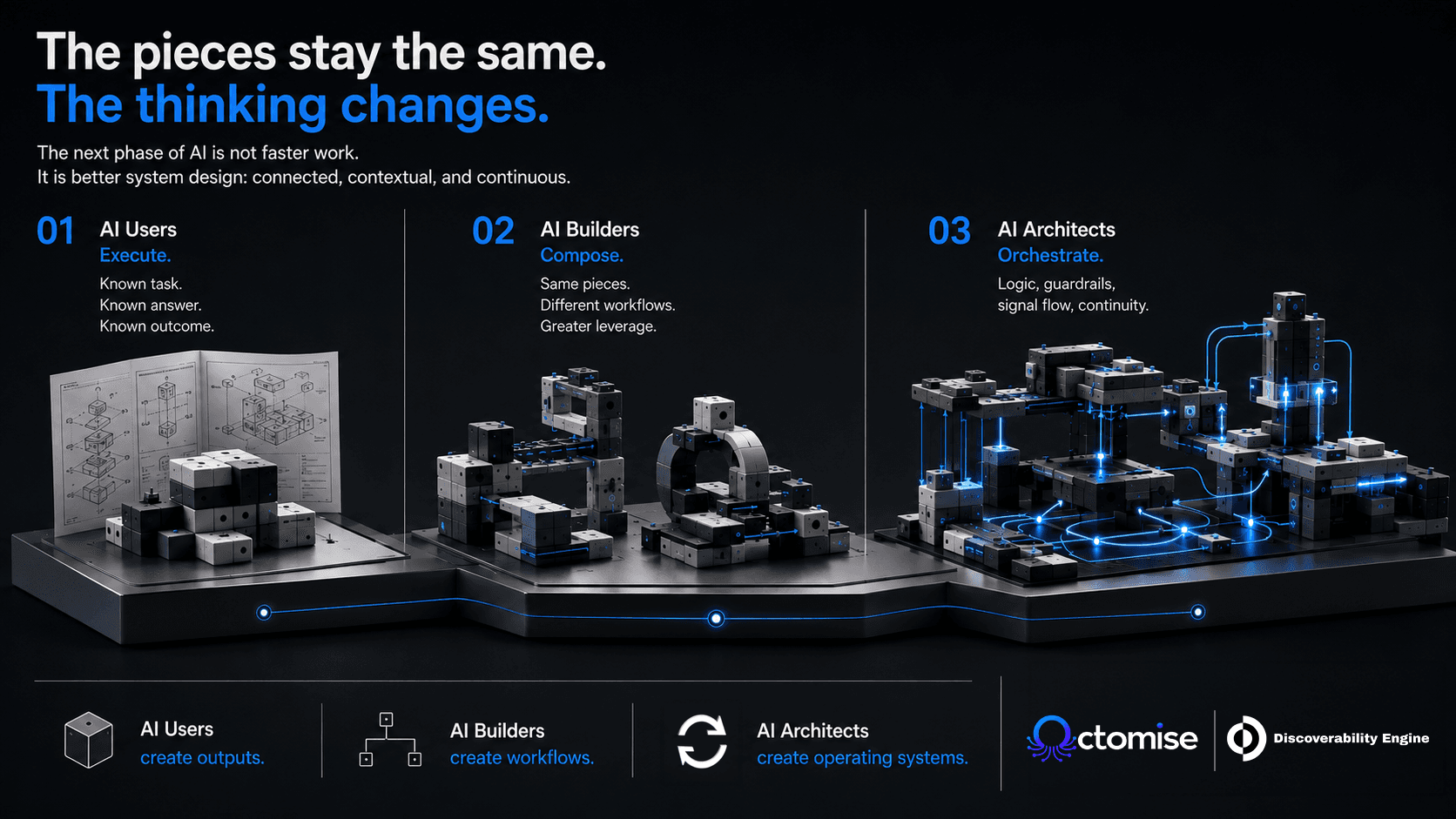
The value is in the system
Most teams entered the AI era through tasks. Write the email faster. Summarise the account faster. Compare vendors faster. Research the market faster.
That phase matters. It creates immediate productivity.
But it also has a ceiling.
When every team has access to similar AI tools, the value is not in the blocks.
The value is in the system.
The pieces stay the same.
The thinking changes.
Phase One: AI Users Execute
The first phase is the easiest to recognise. AI users take a known task and use AI to complete it faster.
In commercial teams, that can mean faster account research, faster market summaries, faster competitor comparisons, faster outreach drafts, and faster preparation before a meeting.
This is useful.
It gives a person more speed and more confidence before action.
With Octomise, this phase becomes more valuable because the work is not starting from a blank prompt. The user can work from richer commercial context: account urgency, market conditions, AI visibility, buyer intelligence, and decision-maker relevance.
That changes the quality of the task.
The output is not just faster.
It is better informed.
Phase Two: AI Builders Compose
The second phase begins when AI is no longer used as a single-task assistant. The same pieces are combined into workflows.
Research connects to prioritisation. Prioritisation connects to outreach. Outreach connects to sequencing. Sequencing connects to response handling.
This is where many teams expect automation to create leverage.
But automation by itself is not enough.
An automated workflow built on weak context simply produces weak actions faster. A sequence can run. A message can send. A follow-up can trigger. But if the logic underneath is stale, generic, or disconnected from the account reality, the automation only scales inconsistency.
This is where Octomise changes the workflow layer.
When existing automated tasks are powered by better intelligence, they become more accurate, more relevant, and more current.
The same outbound motion changes when it understands which accounts are becoming urgent, what market pressure is creating the timing, how AI systems are shaping buyer preference, which decision makers matter, and what message is most commercially relevant now.
The workflow has not become valuable because it is automated.
It becomes valuable because the automation has context.
Phase Three: AI Architects Orchestrate
The third phase is where the human role changes most. The human is no longer sitting in the middle of every manual task.
The human moves to the front of the system.
That is the human-principal role.
Humans define objectives, commercial logic, conditions, thresholds, rules of engagement, guardrails, and escalation points.
Then the system operates within that design.
It monitors signals. It re-prioritises accounts. It keeps context current. It triggers the next action. It maintains continuity across channels, time zones, campaigns, and team availability.
This is no longer AI as a faster assistant.
It is AI as part of an operating system.
Why Continuity Becomes the Advantage
Commercial teams do not only lose momentum because they lack effort.
They lose momentum because continuity breaks.
A market starts moving while a team is at a tradeshow. A priority account changes condition while the campaign list is still static. A buyer replies outside working hours and the response sits untouched. A new stakeholder becomes relevant, but the account map is already out of date. A rep goes on leave and the commercial context stays in their head.
These are not just execution problems.
They are system-design problems.
If the system depends on manual continuity, momentum will always break somewhere.
The next phase of AI value is about reducing those breaks.
Not by removing humans.
By moving humans into the role where they create the most leverage: defining the logic, setting the guardrails, and judging the outcomes.
Where Octomise Fits
Octomise is a Decision Intelligence Platform for the AI buying era.
The Commercial Decision Layer is the concept that explains how it improves commercial systems.
It helps teams move through all three phases: from faster tasks, to smarter workflows, to more continuous operating systems.
At the task level, Octomise improves research, prioritisation, and outreach with stronger commercial context.
At the workflow level, Octomise gives existing automation better intelligence to act on.
At the operating-system level, Octomise helps human principals design the logic that keeps commercial motion aligned, current, and continuous.
GTM is the starting point.
But the same logic extends further: RevOps, sales strategy, account planning, partner motions, event follow-up, market coverage, and decision-maker engagement.
The question is no longer simply how a team can use AI to do more work.
The better question is how a team designs the system that decides what work should happen next.
The New Commercial Maturity
AI users create outputs.
AI builders create workflows.
AI architects create operating systems.
That is the maturity curve commercial teams now have to understand.
The teams that win will not be the teams with the most AI tools.
They will be the teams with the clearest logic, the strongest context, and the best-designed systems for keeping momentum alive.
The pieces stay the same.
The thinking changes.