

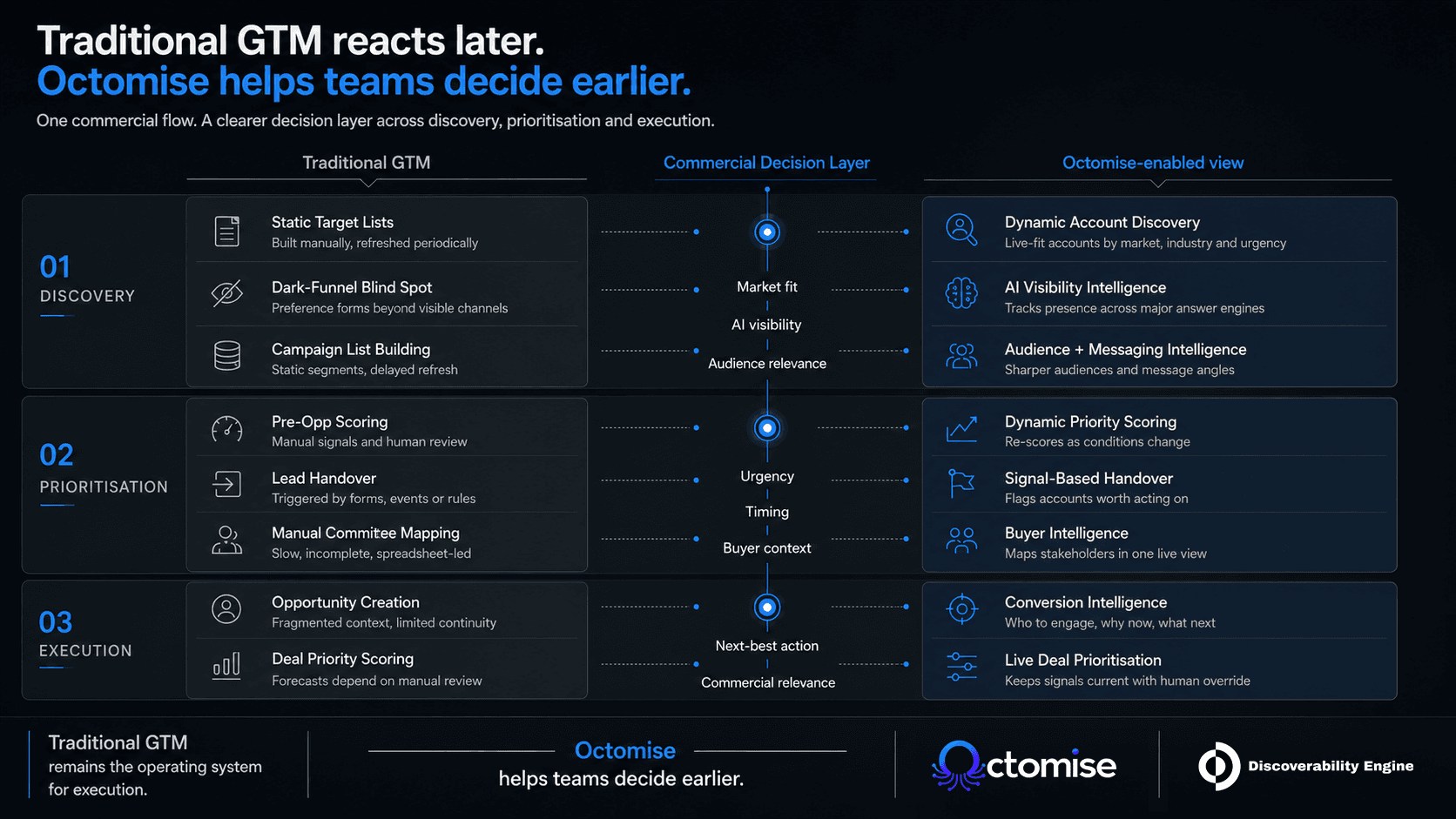
Traditional GTM was built for visible signals
Traditional GTM was built for visible signals. The visible operating model is familiar: website visits, form fills, event scans, email opens, and CRM activity.
Those signals still matter. They remain the operating system for a large part of commercial execution.
The problem is not that they are wrong.
The problem is that they usually appear after important commercial conditions are already changing.
What Traditional GTM Misses
The modern buying environment moves earlier, faster, and with more complexity than the visible funnel was designed to capture.
Buyer preference can begin to form inside answer engines before a website visit ever happens.
Account urgency can increase because of a market shift, hiring move, regulatory change, or strategic announcement before campaign dashboards show meaningful movement.
Decision-maker relevance can change because of timing, internal pressure, or a role shift before a traditional handover rule ever flags the person.
Traditional GTM usually captures these moments after they have already started to matter.
That is the gap the Commercial Decision Layer is designed to close.
What the Commercial Decision Layer Is
The Commercial Decision Layer is not another system that replaces CRM, marketing automation, sales engagement, legal review, procurement, or post-sale execution.
It is the intelligence layer that improves decisions across discovery, prioritisation, and execution.
In practical terms, it combines AI visibility, market fit, audience relevance, urgency detection, buyer intelligence, signal-based handover, and live deal prioritisation.
That combination gives commercial teams a clearer view of who matters, why now, and what to do next.
How It Changes the Flow
Discovery is no longer just about building a target account list. It is about identifying which accounts are becoming commercially relevant now, and why. That requires more than static segmentation. It requires market fit, AI visibility, and audience relevance.
Prioritisation is no longer just about scoring signals and routing leads through fixed thresholds. It is about understanding urgency, timing, and buyer context while those conditions are still moving. That requires dynamic priority scoring, signal-based handover, and a clearer view of the buying group.
Execution is no longer just about creating an opportunity and updating forecast stages manually. It is about deciding who to engage, why now, and what action is commercially justified next. That requires next-best action logic, stronger commercial relevance, and live deal prioritisation support.
Where Octomise Fits
Octomise is a Decision Intelligence Platform for the AI buying era.
Octomise does not argue that traditional GTM should disappear.
It argues that traditional GTM reacts later than many teams assume, because visible signals tend to appear after important commercial conditions are already changing.
That is why Octomise adds a clearer decision layer across the flow.
It helps teams improve commercial decisions through AI visibility, account urgency, buyer intelligence, and more dynamic prioritisation across the GTM flow.
It helps commercial teams discover accounts static lists miss, re-prioritise as conditions change, understand how AI is shaping buyer preference, map decision makers more clearly, and act with better timing and context.
The result is not a different commercial process for its own sake.
It is a better-informed one.
Traditional GTM still drives execution.
Octomise helps teams decide earlier.
What better intelligence changes
The value of better intelligence does not stop at reporting.
It changes continuity.
When market signals, account urgency, buyer context, and decision-maker relevance are already live, agentic automation can keep execution moving without losing the thread.
No market should go cold because a team is away at a tradeshow.
No target account should lose momentum because a rep is on leave.
No high-intent response should sit unattended on LinkedIn because of a time difference.
With the right decision layer underneath it, automation becomes more than speed.
It becomes continuity with context.