

The weakness is continuity
Most go-to-market systems were not designed as learning systems. They were assembled as operating stacks.
Strategy sits in one place. Market research happens somewhere else. Account lists are built separately. Contact data is enriched in another tool. Outreach runs through a different system. Performance is reviewed after the campaign has already moved on.
Each part can be useful.
The weakness is not activity.
The weakness is continuity.
When commercial context breaks between planning, intelligence, engagement, and reporting, teams lose more than time. They lose the thread of why an account matters, who should be engaged, what changed, and what should happen next.
That is the gap Octomise is built to close.
From Automation to Decision Intelligence
Automation made commercial execution faster. It helped teams send more emails, sequence more contacts, route more leads, and move more work through the system.
That speed matters.
But faster execution does not automatically create better decisions.
An automated workflow built on stale account logic still produces stale actions. An email sequence built on weak buyer context still reaches the wrong person with the wrong message. A scoring model built on visible signals alone still reacts after the market has already moved.
The next step is not simply more automation.
It is decision intelligence.
Decision intelligence means the system understands the commercial logic underneath the action. It knows which accounts matter, why they matter now, which people are relevant, what market conditions have changed, and what action is most justified next.
Octomise turns GTM from a sequence of manual tasks into a continuously learning commercial operating system.
The Human Decision Owner
The closed loop starts with a human decision owner.
This matters.
Octomise is not designed around the idea that humans disappear from commercial execution. It is designed around a clearer division of responsibility.
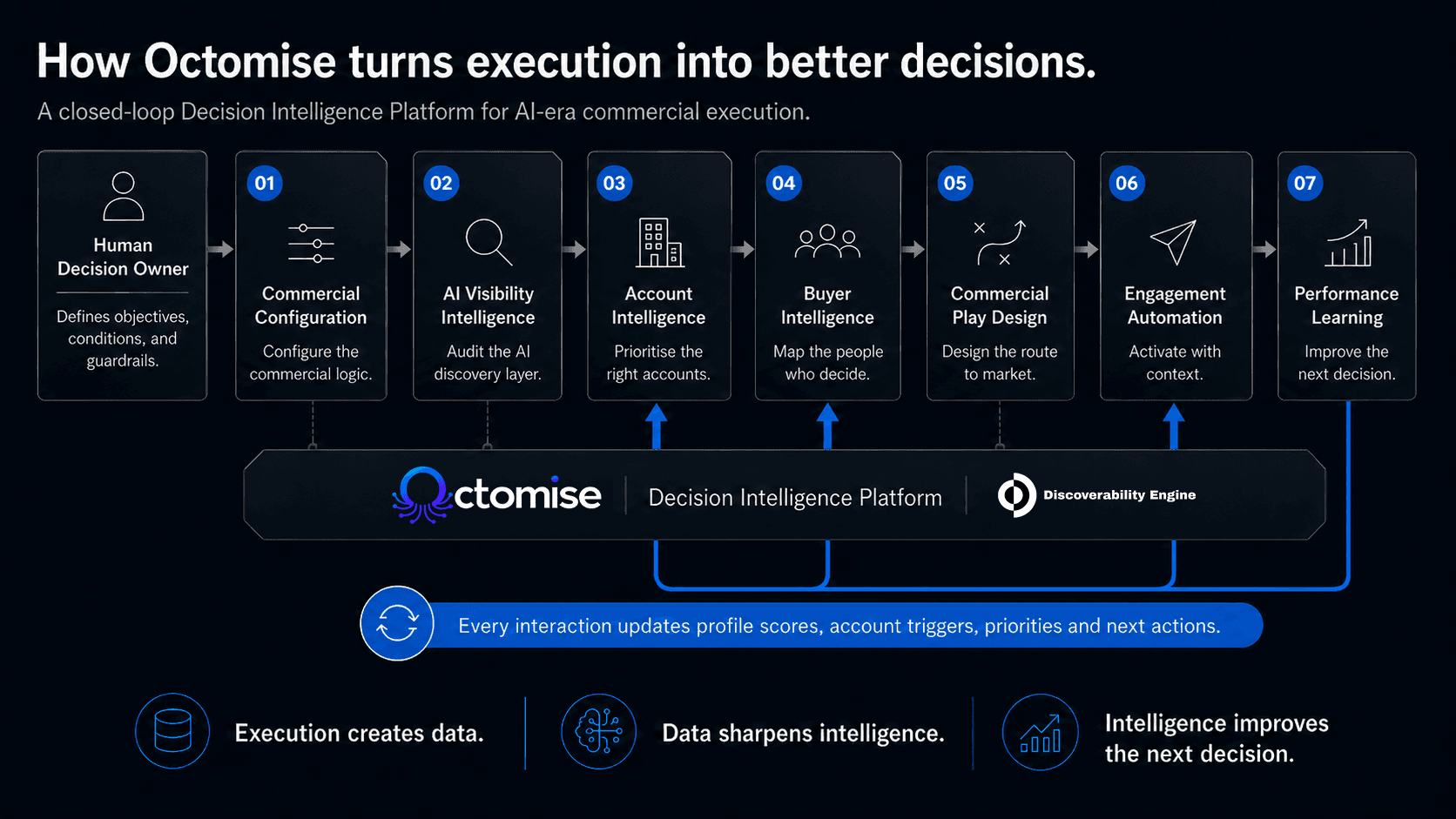
The human decision owner defines objectives, commercial conditions, account logic, buyer criteria, guardrails, escalation points, and acceptable automation boundaries.
The platform then operates inside that logic.
This moves human value upstream.
Instead of manually holding every task together, the human defines the system that decides what should happen next.
How the Octomise Loop Works
Octomise connects seven operating stages into one decision intelligence loop.
Commercial Configuration is where the market logic is defined: the client, category, products, regions, countries, industries, competitors, target conditions, and buyer personas that matter for the workspace. The goal is not to create a generic database. The goal is to configure the commercial logic that the platform should use when deciding what is relevant.
AI Visibility Intelligence audits the AI discovery layer. It helps teams understand where a brand appears, where it is missing, which competitors are being surfaced, what sources are being cited, and where the AI discovery journey is shaping buyer perception before visible funnel signals appear.
Account Intelligence turns broad market coverage into account intelligence. It identifies which organisations match the configured conditions, which accounts show structural relevance, and which should be prioritised for monitoring or engagement.
Buyer Intelligence maps the stakeholders, roles, functions, pain points, authority levels, and engagement paths inside each target account. The output is not just contact enrichment. It is a clearer understanding of the buying committee and the different reasons each stakeholder may care.
Commercial Play Design translates intelligence into routes to market. Different signals require different motions, and the play is designed around the account condition, not around a generic campaign theme.
Engagement Automation activates the play with context. LinkedIn connection requests, messaging, email sequences, event invitations, follow-ups, and other engagement actions can be generated, reviewed, approved, scheduled, and launched.
Performance Learning closes the loop. Replies, meetings, clicks, downloads, bounces, acceptances, event registrations, survey responses, and non-responses should not sit in a report after the fact. They should improve the system.
Every interaction updates profile scores, account triggers, priorities, and next actions.
That is the difference between reporting and learning.
Why the Feedback Loop Matters
The feedback loop is the most important part of the architecture.
In traditional GTM, performance data often arrives at the end of a campaign. By then, the team may already be preparing the next list, building the next sequence, or shifting attention to the next event.
The learning does not always return to the decision points that need it most.
Octomise is designed differently.
Performance data flows back into the system where it can sharpen account intelligence, buyer intelligence, engagement automation, prioritisation, and next best action.
If an account opens repeatedly but does not reply, the next action should change. If a buyer accepts a connection and engages with a specific theme, the profile score should change. If a bank shows stronger urgency around a particular risk condition, the account priority should change. If a sequence is creating attention but not meetings, the commercial play should change.
The point is not to collect more performance data.
The point is to make performance data useful before the next commercial decision is made.
GTM Needs Continuity
Commercial teams do not only lose momentum because they lack effort.
They lose momentum because context breaks.
A market moves while the team is away at a tradeshow. A buyer replies across a time zone and the response waits. A target account becomes urgent while the campaign list remains unchanged. A stakeholder changes role and the buying committee map becomes stale. A rep goes on leave and the commercial context stays in one person's head.
These are not only execution problems.
They are continuity problems.
GTM does not only need more automation.
It needs continuity.
Where Octomise Fits
Octomise is a Decision Intelligence Platform for AI-era commercial execution.
It does not replace CRM, marketing automation, sales engagement, legal review, procurement, or post-sale execution.
It improves the decisions running through the commercial system.
It helps teams configure the logic, understand AI visibility, prioritise the right accounts, map the people who decide, design commercial plays, activate engagement with context, and learn from performance.
The result is a system where execution does not end as a report.
Execution becomes new intelligence.
The Next Commercial Decision
The strongest commercial systems will not be defined by the number of tools they contain.
They will be defined by how well those tools preserve context and improve decisions.
That is the shift Octomise is designed for.
Execution creates data.
Data sharpens intelligence.
Intelligence improves the next decision.