

Commercial Teams Do Not Need More Noise
Most commercial teams are not short of data.
They already have CRM records, campaign reports, intent signals, website analytics, sales notes, event lists, partner updates, analyst feedback, pipeline dashboards, and engagement metrics.
The issue is not the absence of information.
The issue is confidence.
Which account should matter now? Which buyer is relevant? Why is the timing changing? What evidence supports action? What should happen next?
When those questions remain unclear, more data does not create better execution. It creates more debate.
Octomise is built to close that confidence gap.
Track First. Then Decide Where To Spend.
Many GTM systems become clearer after budget has already been deployed.
Campaigns create engagement. Ads create audiences. Content creates downloads. Retargeting creates identifiable behaviour. Events create attendee lists.
Those signals are useful.
But they often arrive after the team has already chosen where to spend.
Octomise helps move intelligence earlier in the cycle.
Before committing more activity or budget, teams should understand where market movement, AI visibility, account fit, buyer relevance, and competitive pressure already point to commercial opportunity.
The point is not to replace campaign investment.
The point is to build confidence first, then decide where spend should go.
External Intelligence Meets Internal Evidence
Decision confidence needs both sides of the market.
It needs external intelligence: what is changing outside the organisation.
It also needs internal evidence: what the commercial system already knows, controls, and learns.
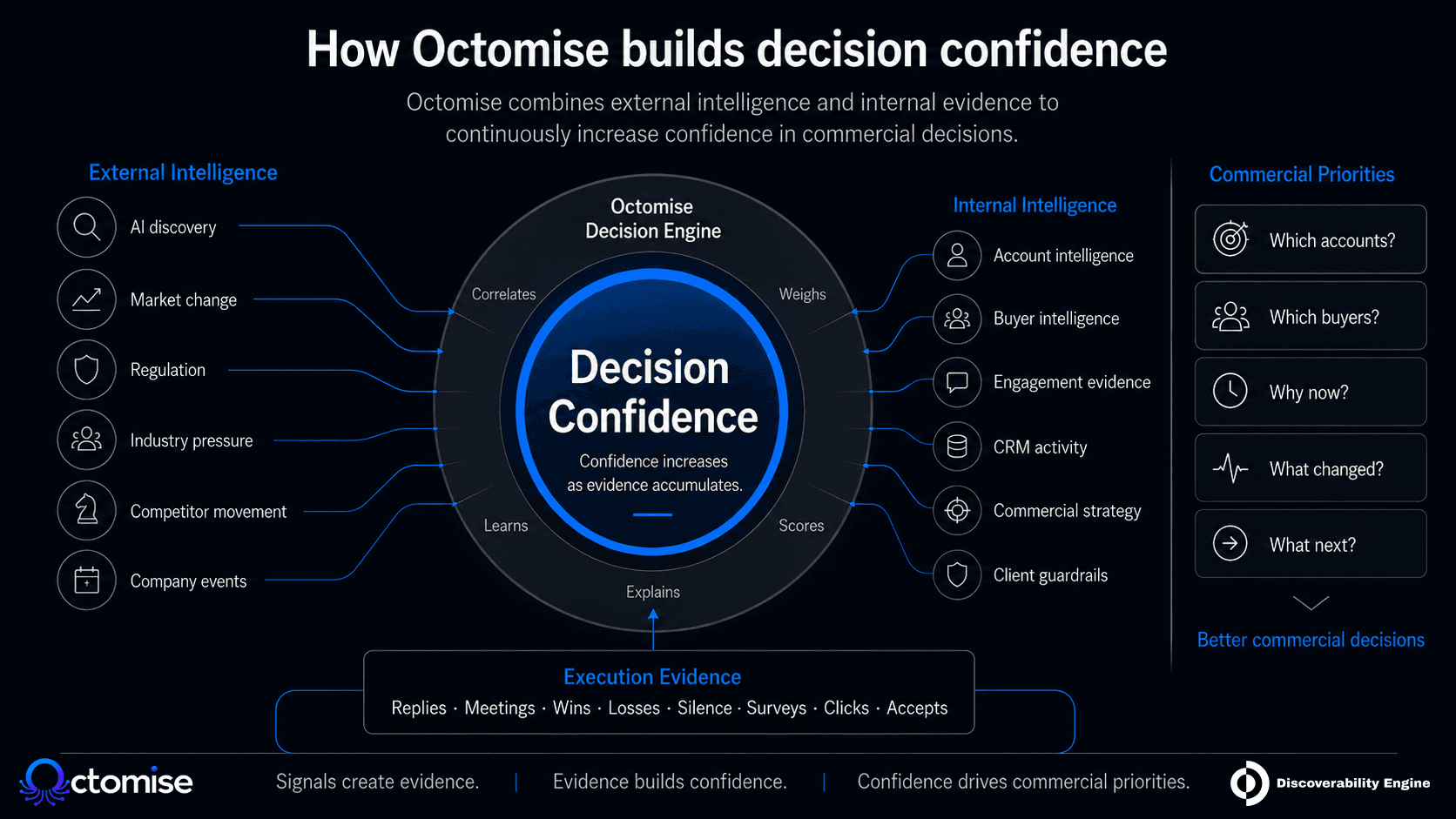
External intelligence includes AI discovery, market change, regulation, industry pressure, competitor movement, and company events.
Internal evidence includes account intelligence, buyer intelligence, engagement evidence, CRM activity, commercial strategy, and client guardrails.
The value is not simply that these signals exist.
The value is that they are interpreted together.
A regulatory shift may matter more when an account already shows relevant exposure. A competitor may become more dangerous when AI systems start recommending them more often. A buyer may become more important when engagement evidence shows interest around a specific problem.
Octomise combines external market reality with internal commercial context.
The Octomise Decision Engine
The Octomise Decision Engine interprets signals through client-approved commercial logic.
It can correlate, weigh, score, learn, and explain, but the mechanics are not the buyer outcome.
The buyer outcome is decision confidence.
That distinction matters because serious enterprise systems should protect their proprietary scoring logic, weighting methods, exact source logic, and methodology.
The purpose is not to expose a formula.
The purpose is to make commercial priorities more defensible.
Teams should be able to see why an account, buyer, market, or next action has become more commercially relevant without requiring the platform to reveal the protected model behind every calculation.
Decision Confidence
Decision confidence is the confidence that a commercial action is justified by evidence.
It does not mean certainty.
It does not mean the platform knows everything.
It means the team has a clearer view of why an account matters, why a buyer matters, why timing matters, what changed, and what action is most reasonable next.
Confidence increases as evidence accumulates.
A single weak signal may not justify action.
Multiple aligned signals can.
Octomise does not only aggregate signals.
It builds decision confidence.
From Confidence To Commercial Priorities
Decision confidence becomes useful when it helps teams answer the questions that drive action: which accounts, which buyers, why now, what changed, and what next.
Commercial teams rarely suffer from a lack of possible actions.
They suffer from too many possible actions competing for attention.
Without decision confidence, prioritisation becomes opinion-driven.
With stronger evidence, prioritisation becomes clearer.
That is why the output should not be treated as generic recommendations.
The output is commercial priorities.
Priorities are operational. They help teams decide where attention, action, and investment should go first.
Execution Evidence Improves The Next Decision
Execution should not end as reporting.
It should become evidence.
Replies, meetings, wins, losses, silence, surveys, clicks, accepts, bounces, and non-responses all carry commercial meaning.
A reply may validate a buyer angle. A meeting may confirm urgency. A loss may expose a competitor gap. Silence may reveal weak timing, weak fit, or weak messaging.
The value of execution evidence is not that it fills another dashboard.
The value is that it improves the next decision.
Signals create evidence. Evidence builds confidence. Confidence drives commercial priorities.
Confidence Drives Better Commercial Decisions
Octomise is a Decision Intelligence Platform for the AI buying era.
It combines external intelligence, internal evidence, and execution feedback to help commercial teams understand which accounts matter, which buyers to engage, why now, what changed, and what to do next.
That does not remove human judgement.
It gives human decision owners a stronger evidence base for the decisions they already need to make.
The strongest commercial systems will not be judged only by how much data they collect.
They will be judged by how clearly they help teams decide what deserves attention, action, and investment.