

Marketing Now Has Two Audiences
Today, tech giants like Google are increasingly pushing AI search or LLMs like Gemini as the first touch point over traditional browsers like Chrome.
If a user Googles for any kind of information, he or she is first directed towards AI search functionalities like AI Overviews and AI Mode. User is expected to find what they are looking for in the search answers and then, if required, dig deeper into the relevant links.
Google pushing AI search essentially proves that the future is of AI acting as a middleman between businesses and their audience.
It is safe to say that in the AI-first world, marketers have two sets of distinct audiences: humans and machines.
Any online marketing campaign or communication that is intended for humans is now first ingested by AI / large language models (LLMs) like ChatGPT, Claude, Gemini and others. It is then presented to the humans as answers within LLMs.
This means that traditional marketing strategies need to evolve in order to cater to both humans and machines.
Let us look at some of the marketing strategies, their efficacy and how they need to change in the AI-first world.
Strategy Example 1: Gated Knowledge Resources
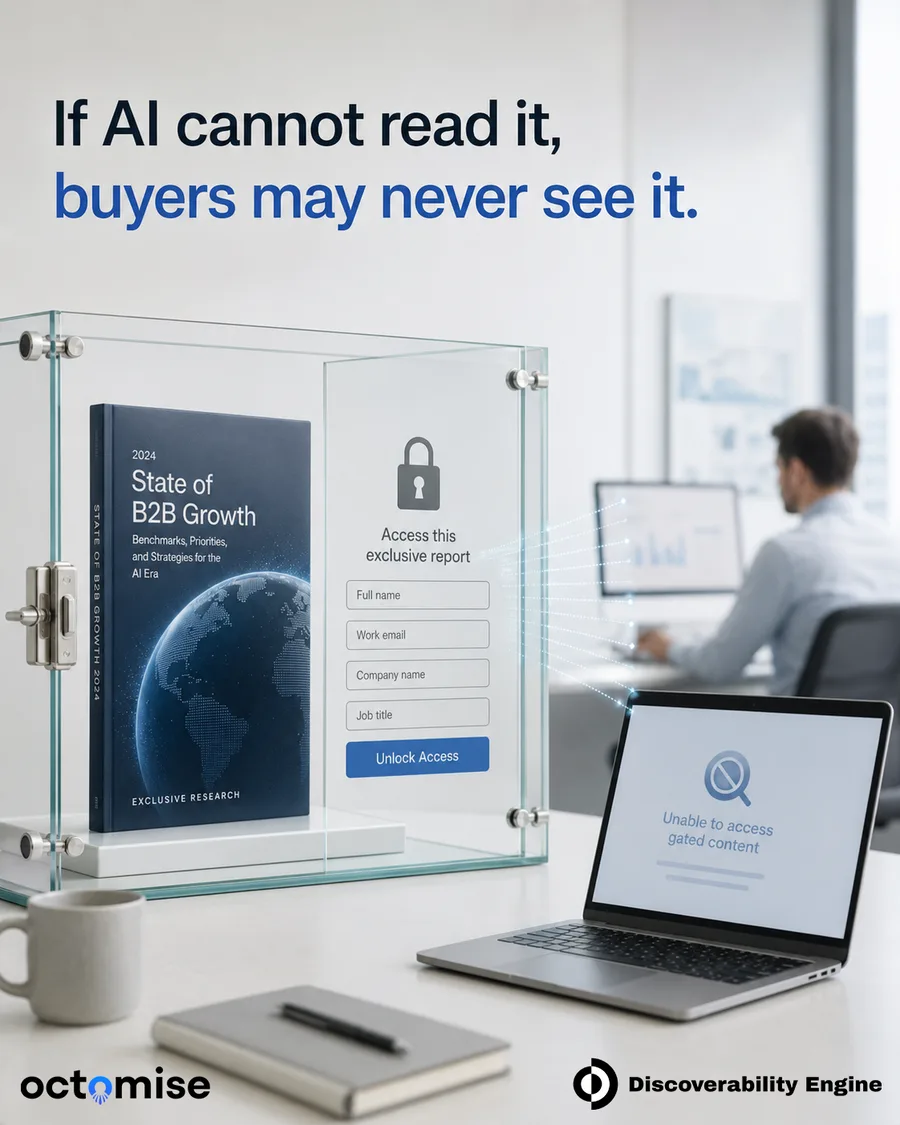
A typical B2B marketing strategy is to have gated knowledge resources like industry reports, webinars etc and get the target customers to fill up forms in order to download them. People who fill up the forms are then targeted and nurtured for sales conversion.
A human may download gated industry reports and webinars, but an AI agent looking for answers may not.
The AI agent, which is now just as valuable as a human, has time and token constraints to perform real-time searches, make sense of it, synthesise an answer and present it to the user.
Most of the humans today who are looking for knowledge resources would actually just go to LLMs and ask direct questions. It is just a human habit forming out of convenience.
If an AI agent cannot figure that a certain resource is valuable because it is gated, how is it going to present it to a human?
AI agents consider these contact forms, surveys or advertisement pop-ups as friction in their time and token-bound functioning.
Strategy Example 2: Cold Traffic to Landing Pages
Another strategy B2B marketers deploy is to drive cold traffic to website landing pages. These landing pages often either provide free trial or a product demo.
Mass cold emailing is a strategy of the past. If a marketer is still doing it, he or she is just burning up the marketing budget without assessing what the ideal market or customer should be.
The world is changing rapidly. Business decisions are not just driven by intent or by the way of being operational in a certain industry.
Decisions are driven by market conditions, geo-political situations, technological advancements, foreign investments, demographic composition, government schemes and benefits, taxation policies and much more.
Intelligent assessment of markets by AI, vetted and value added by experienced human analysts, provide the correct window to target a certain industry or business.
This enables marketers with speed and accuracy which traditional research cannot. Outreach to these well qualified leads allows for higher conversion chances.
Our teams at Octomise live by the principle of relevance over volume.
We provide time-sensitive marketing insights enabling our partner businesses much before their competitors.
Strategy Example 4: High-Volume Content
Many B2B marketers are in the game of high-volume content written by low-quality writers or even by LLMs like ChatGPT and Gemini. They try to focus on keyword-heavy content in order to drive views.
Businesses going heavy on AI-generated content do not realise that this strategy is very harmful.
Why would an AI use your content to train or synthesise an answer when it already knows everything that is inside it already?
When LLMs were first introduced to the world, it created a panic amongst people who made a living writing content.
Businesses started using LLMs / AI to write content in volume without realising they are just compromising on quality and recycling what is already on the web.
Today, quality over quantity is important.
The value of good content writers is not going down. Instead, they can now charge a premium for original high-quality content.
Marketing, Sales and Technical Teams Need to Work Together
In a B2B enterprise business, marketing, sales and technical teams have often worked in silos.
This will not work in the future.
All the teams need to work in tandem, thinking about technical aspects for machines and behavioural aspects for human audience, coming together to form a strong digital footprint.